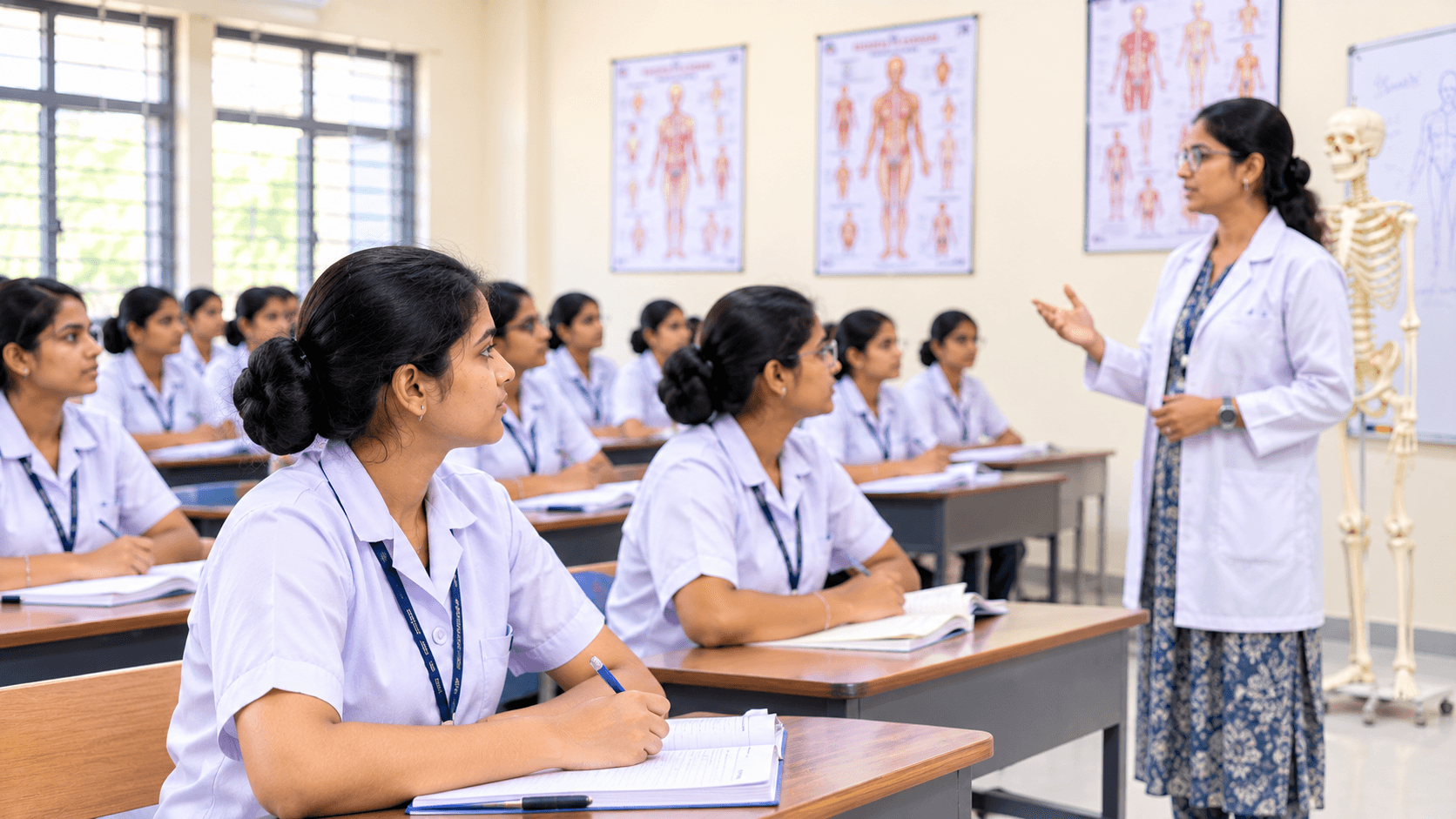
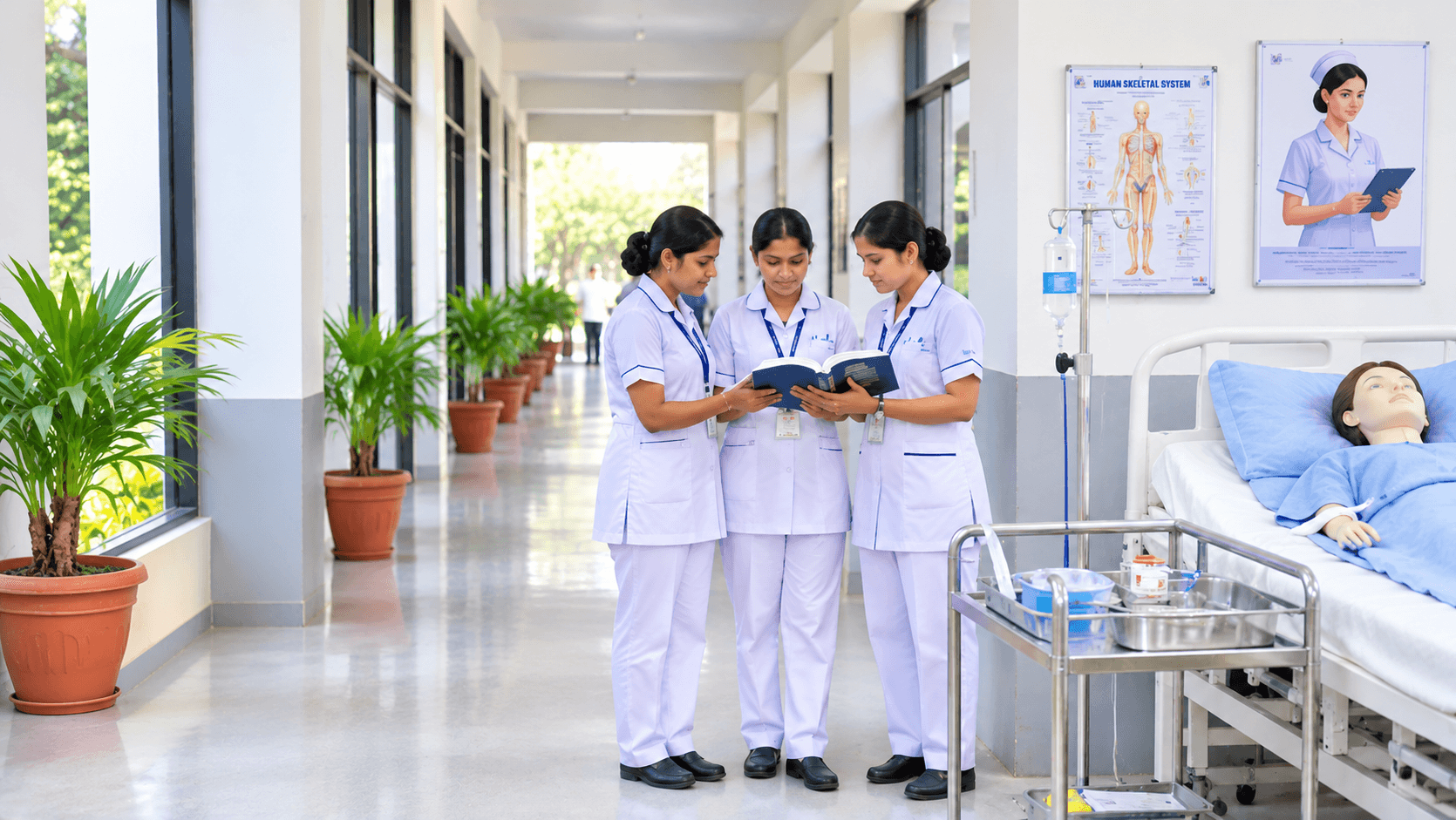
General Nursing and Midwifery (GNM) is a diploma-level nursing programme that provides students with foundational knowledge of nursing sciences, patient care, and professional healthcare practices.
The course introduces students to important areas of healthcare, including medical and surgical nursing, community health, child health, mental health, and midwifery.
Through classroom learning, practical instruction, and supervised clinical experience, students develop the knowledge and skills needed to understand professional nursing responsibilities.
Fundamentals of Nursing
Patient Care & Safety
Medical-Surgical Nursing
Community Health Nursing
Maternal & Child Healthcare
Professional Nursing Ethics
Learning with Compassion
Knowledge • Skills • Patient Care
Admission Requirements
GNM Course Eligibility
Review the general entry requirements before applying. Confirm the exact criteria for the current academic session with the college.
Educational Qualification
10+2 or equivalent
Recognized board or equivalent qualification, subject to current admission rules.
Minimum Marks
As per applicable admission norms
Applicable percentage and subject requirements must be confirmed for the admission session.
Age Requirement
As per current regulatory norms
Age limits and cut-off dates follow applicable admission guidelines.
Admission Requirements
Document verification
Admission is subject to eligibility, documentation, and applicable procedures.
Eligibility Notice: Final admission criteria, including qualifying subjects, marks, age, medical fitness, and selection procedures, follow applicable rules and the official admission notification.
Academic Journey
GNM Course Curriculum
Explore the broad areas of study commonly covered during the three-year GNM programme. Exact subject titles and schedules follow the approved syllabus.
01
Academic Year 01
First Year
Building the Foundation
Introduction to nursing principles, basic sciences, and essential patient-care concepts.
Key Areas of Study
Anatomy & Physiology
Microbiology
Fundamentals of Nursing
First Aid
Community Health Nursing
Psychology & Sociology
Health Education & Communication
02
Academic Year 02
Second Year
Developing Clinical Understanding
Progressive learning in nursing care across different healthcare needs and patient groups.
Key Areas of Study
Medical-Surgical Nursing
Mental Health Nursing
Child Health Nursing
Clinical Nursing Practice
Care Planning & Documentation
Patient Safety & Infection Prevention
03
Academic Year 03
Third Year
Advancing Professional Readiness
Further study in maternal health, community care, and professional nursing responsibilities.
Key Areas of Study
Midwifery & Gynaecological Nursing
Community Health Nursing
Maternal & Newborn Care
Nursing Education
Professional Trends & Adjustment
Nursing Administration
Supervised Clinical Learning
Curriculum is indicative and must be checked against the applicable approved syllabus. Clinical rotations and other training components follow relevant regulations.
Learning Beyond the Classroom
Practical & Clinical Training
Practical education helps nursing students connect classroom knowledge with patient-care responsibilities.
Hospital-Based Learning
Understanding patient care in supervised healthcare settings.
Medical & Surgical Care
Developing familiarity with clinical procedures and nursing responsibilities.
Maternal & Child Health
Learning principles of maternity, newborn, and child healthcare.
Community Health
Understanding preventive care, health education, and community needs.
Patient Safety
Learning hygiene, infection prevention, observation, and safe care principles.
Communication & Teamwork
Developing professional communication and collaborative care skills.
Clinical Training Information: Specific hospital affiliations, clinical rotation schedules, facilities, and training locations should be confirmed directly with the college.
Join Lake View
GNM Admission Process
A simple overview to help prospective students understand the usual stages of applying for the GNM programme.
01
Enquire
Contact the admission office for current session details, eligibility, seats, and application information.
02
Check Eligibility
Review the required qualifications, applicable rules, and supporting documents.
03
Submit Application
Complete the application using the official procedure and deadlines communicated by the college.
04
Verification & Admission
Complete document verification and any applicable selection or admission formalities.
Application Checklist
Documents Required
Class 10 marksheet and certificate
Class 12 marksheet and certificate
Transfer or school leaving certificate, if required
Character certificate, if required
Passport-size photographs
Valid identity proof
Category or residence certificate, if applicable
Medical fitness certificate, if required
Other documents mentioned in the admission notice
This is a general preparation checklist. The official document list may differ.
GNM can provide a foundation for nursing-related professional opportunities and further education, subject to registration and eligibility requirements.
Hospital Nursing
Explore nursing roles in hospitals and healthcare facilities, subject to applicable registration and recruitment requirements.
Community Healthcare
Opportunities may exist in community-based health programmes and public health services.
Maternal & Child Care
Explore care settings focused on maternal, newborn, and child health.
Clinical Care Services
Potential opportunities in different patient-care environments and nursing services.
Higher Education
Eligible graduates may pursue further nursing education, such as Post Basic B.Sc. Nursing, subject to admission requirements.
Healthcare Organisations
Explore relevant roles in eligible healthcare institutions and support services.
Employment, registration, licensing, and further-study eligibility depend on applicable requirements. No placement guarantee is implied.
Common Questions
Frequently Asked Questions
Find answers to common questions about the GNM course, eligibility, training, and admissions.
01What is the full form of GNM?
GNM stands for General Nursing and Midwifery. It is a diploma-level nursing programme focused on foundational nursing education, patient care, and midwifery.
02What is the duration of the GNM course?
The GNM programme is generally structured as a three-year course. Confirm the current academic and practical training requirements with the college.
03Can I apply for GNM after Class 12?
Candidates who have completed 10+2 may be eligible, subject to applicable requirements relating to subjects, marks, age, and other admission conditions.
04Is clinical training included in GNM?
Practical and supervised clinical learning are important components of GNM education. Specific training arrangements and affiliations should be confirmed with the college.
05What are the GNM course fees?
Please contact the admission office for the official fee structure, payment schedule, and any additional charges.
06What can I do after completing GNM?
Eligible graduates may pursue nursing-related roles subject to registration and recruitment requirements, or explore higher education such as Post Basic B.Sc. Nursing.
07How can I apply to Lake View College of Nursing?
Contact the college admission office to confirm the current application process, admission dates, required documents, and eligibility criteria.
08Does the college provide hostel facilities?
Hostel availability and related charges have not been confirmed. Please contact the college for the latest information.
Admission Enquiry
Interested in GNM Nursing?
Get in touch with our admission team for course eligibility, fee details, available seats, admission procedures and other enquiries.